“Whitbread bought Berni in 1995.”
The deal was announced in late November 1990 and later business chronologies record it in 1991. The mid-1990s better describes the disappearance of the old Berni branding.
The Berni connection
Beefeater was not a renamed Berni Inn and the Berni brothers did not found it. But Whitbread eventually bought Berni’s estate, converted many of its restaurants and absorbed a dining formula Berni had helped invent.
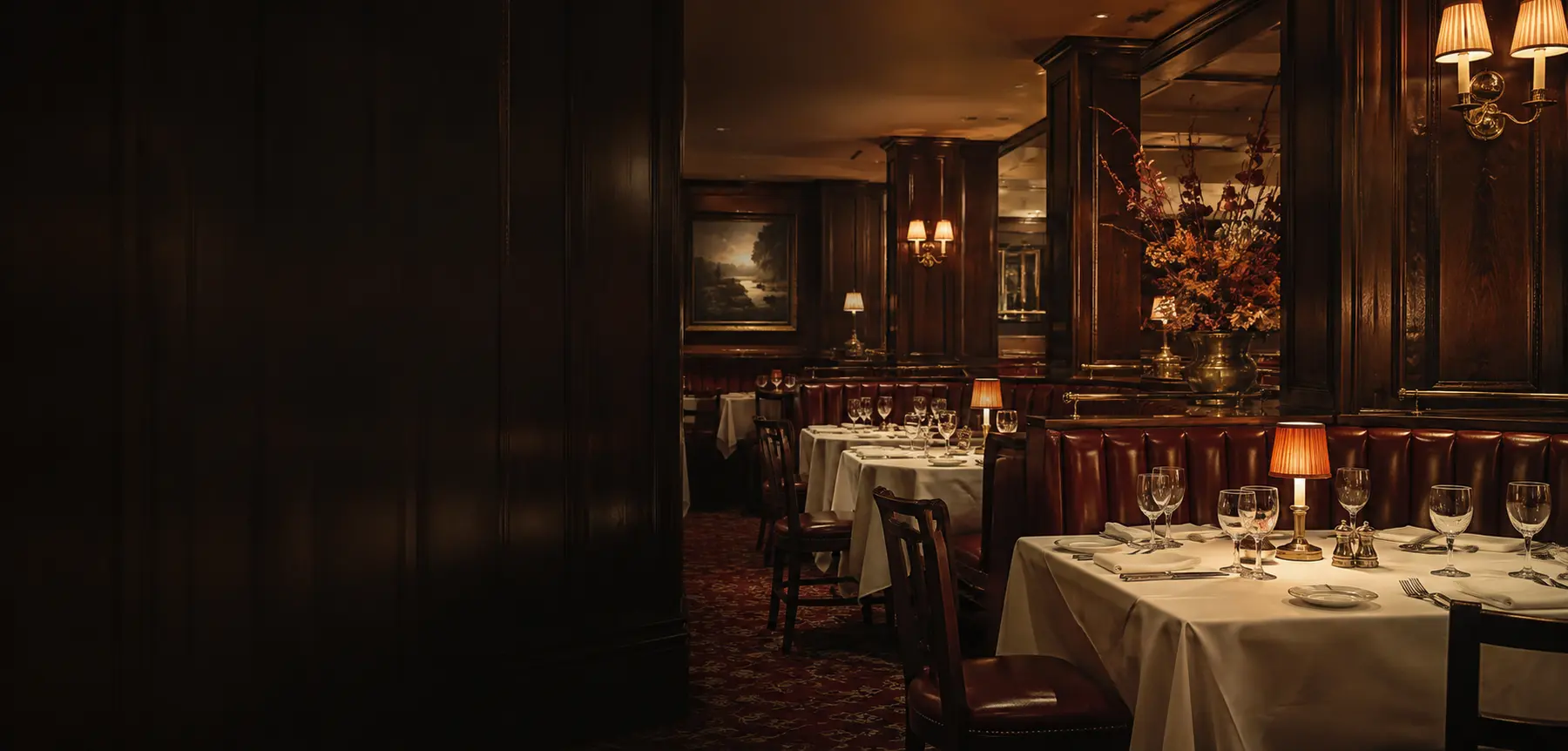
Original editorial reconstruction · fictional unbranded British steakhouse · not a real Berni Inn
In brief
The connection is real, but it begins sixteen years after Beefeater opened. Beefeater started independently; Berni later became part of its corporate and property ancestry.
What the internet gets wrong
The real connection is interesting enough. It does not need a false founding story, a five-year date drift or an imagined link to a bottle of gin.
The deal was announced in late November 1990 and later business chronologies record it in 1991. The mid-1990s better describes the disappearance of the old Berni branding.
Beefeater opened in 1974, sixteen years before the acquisition. Some Berni sites later became Beefeaters, but the chains had separate founders and origins.
Frank and Aldo Berni helped create the British mass-market steakhouse formula. Whitbread created Beefeater independently and later inherited part of Berni’s estate.
No corporate or causal link has been found. The gin traces its name to the Yeoman Warders; the restaurant brand belonged to Whitbread. The exact restaurant-name decision remains undocumented in the sources found.
Before Beefeater
Their breakthrough was not simply steak. It was removing uncertainty: recognisable surroundings, a short menu, known prices and service that felt formal without demanding prior restaurant experience.
Frank and Aldo Berni came from an Italian family associated with cafés and temperance bars in South Wales and the West Country. After building businesses in Exeter, Plymouth and Bristol, they studied the consistent, margin-conscious steak bars emerging in the United States.
At Bristol’s Rummer, an old inn became the setting for a modern system: a compact wine list, few menu decisions, repeatable kitchens and a carefully cultivated “olde worlde” atmosphere. The result felt local, but could be reproduced nationally.
By 1970 Berni had 147 British restaurants and hotels. Grand Metropolitan bought the company, later expanding it with other holdings before the estate passed to Whitbread.
The archive preserves a description and short quotation for research, but no longer displays or distributes the reader-supplied scan while its publication, creator and reuse permission remain unknown.
Advertising ephemera
The advert turns an alarming kitchen flare-up into an excuse to dine out. Its promise is pure Berni: reliable steak, fish and poultry, wine and friendly service—presented as an affordable little occasion rather than a grand restaurant commitment.
“For a great steak at a fair price—you’re better off at a Berni.”
The scan was supplied by a reader. Its original newspaper, publication date, photographer and reuse rights have not yet been identified. The image is therefore withheld. The archive welcomes permission, firmer provenance, credit information or a correction.
The family tree
Frank and Aldo Berni use a £300 inheritance to buy a café in Exeter, building on their family’s experience of Italian-run cafés and temperance bars.
The brothers acquire Hort’s in Bristol, an established multi-room restaurant whose grills, oyster bar and liquor licence provide a platform for expansion.
Sources disagree on the exact launch year, but agree on the place and idea: The Rummer in Bristol becomes a fixed-price steakhouse inspired by American chain consistency.
Rapid replication is supported by a tightly controlled menu, detailed operating manuals and interiors that made a restaurant feel reassuringly pub-like.
Grand Metropolitan buys the business. The brothers retire from a chain that had helped turn restaurant dining into an attainable middle-class ritual.
Whitbread opens Beefeater independently at The Halfway House in Enfield. Similar menu territory made the two chains competitors, not relatives.
Contemporary reporting says Whitbread agreed to buy Berni Inns from Grand Metropolitan in late November. Completion and later corporate chronologies run into 1991; former properties then move into several Whitbread formats or disposals.
Later summaries often call 1995 the takeover year. Contemporary business reporting instead places the purchase in 1991; 1995 is better treated as the period by which the old branding had vanished.
Side by side
| Question | Berni Inn | Beefeater |
|---|---|---|
| Origin | Bristol, developed from the Rummer prototype in the mid-1950s | Enfield, launched by Whitbread in 1974 |
| Founders | Frank and Aldo Berni | Whitbread |
| Core promise | Fixed-price, accessible sophistication | Dependable steakhouse food in a pub setting |
| Signature meal | Prawn cocktail, steak and chips, Black Forest gâteau | The same cultural territory, later expanded around a visible chargrill |
| Operating method | Limited choice, detailed manuals and tight cost control | Standardised chain operation with repeated menu and design refreshes |
| Relationship | Sold to Grand Metropolitan in 1970; £115m Whitbread deal announced in November 1990 | Began as a competitor, then inherited part of Berni’s estate |
A building that proves it
The ground floor of the historic Mitre Hotel became a Berni Inn in 1967. Oxford’s building history records Whitbread’s takeover in 1990, after which the restaurant became a Beefeater. It later traded under other names and reopened as Gusto in 2022.
It is a rare, cleanly documented example of the path from Berni to Beefeater at one address.
Read the building history ↗Research note
The Financial Times described the transaction as a £115 million deal. A contemporary Business Times brief rounded it to approximately £120 million and said it covered 150 restaurants. A later Independent corporate chronology places the transaction across 1990–91, consistent with announcement followed by completion or accounting.
Many later pages instead say Whitbread bought Berni in 1995. That date does not fit the contemporary record and probably reflects the final disappearance of the Berni name or later conversions. This archive uses November 1990 for the agreement, 1991 where later chronologies record the transactionand the mid-1990s for the end of the branding.
Contemporary announcement ↗Financial Times archive ↗1995 chronology ↗